Dissertation
|
From the inside, conscious experience seems to exhibit a kind of essential unity. In my dissertation work, I subjected the intuition that minds are numerically singular and necessarily unified to critical scrutiny using test cases. I argued that questions of “counting minds” do not always have metaphysically determinate, whole-number answers. On this page, you can find a video summary of the project as well as descriptions of two of my case studies.
|
|
The craniopagus case
|
Krista and Tatiana are remarkable little girls, and their existence was a big reason for my initial interest in Neuroscience and philosophy of mind (see the documentary Inseparable, and Susan Dominus' New York Times piece on the girls). They are craniopagus twins conjoined at the head, sharing a "thalamic bridge" connecting the sensory processing areas in their brains. This allows them to share sensations, control each other's limbs, and even hear each others' thoughts. This motivates the idea that biology doesn't place necessary constraints on the privacy of mental contents.
|
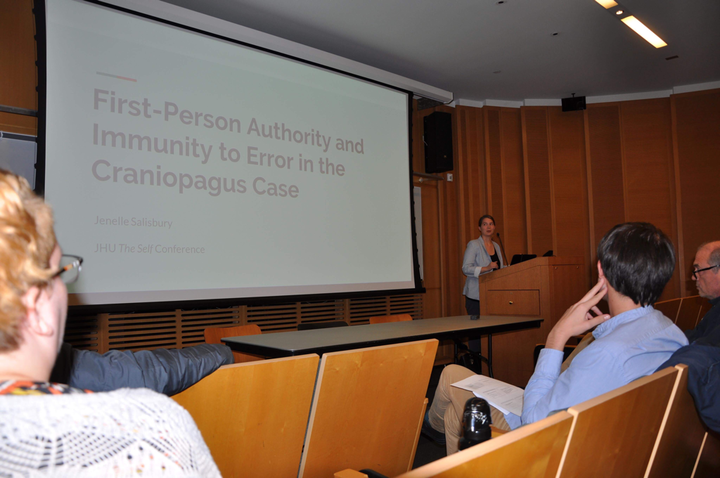
Here I am presenting some work on the Craniopagus twin case at a conference at JHU.
|
THE Split-Brain CASE
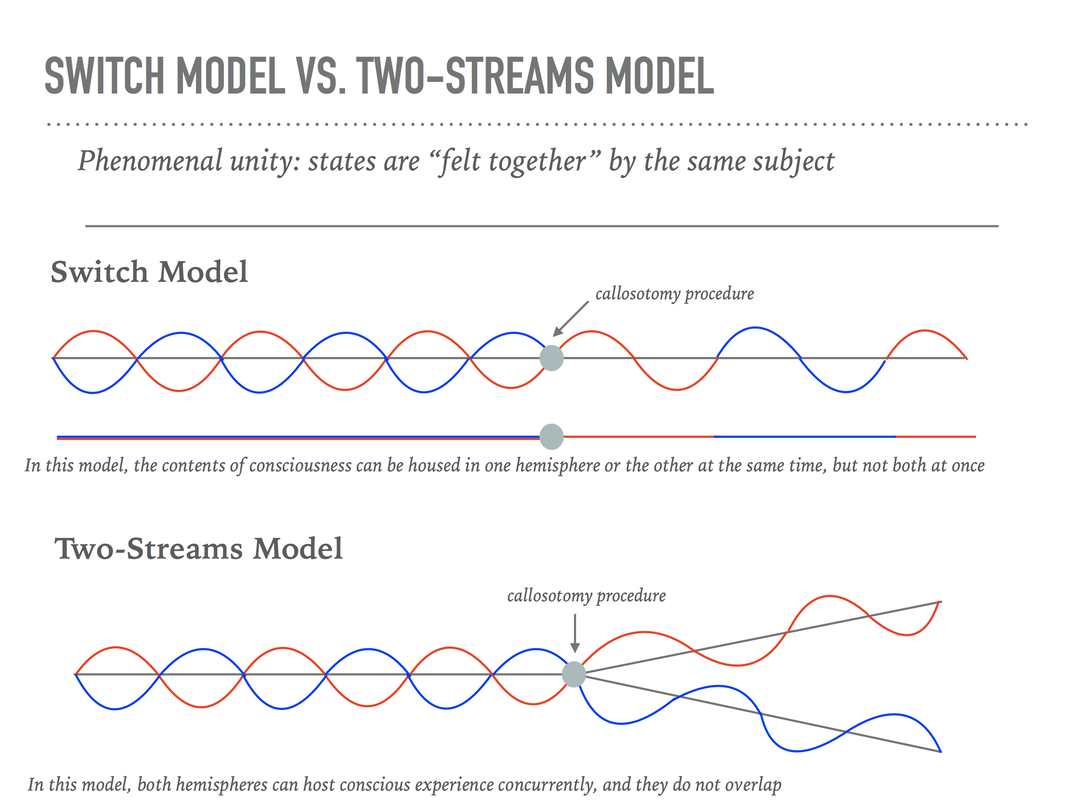
This diagram characterizes how I think about two prominent models for the structure of conscious experience in the split brain: Bayne's "switch" model and the "two-streams" model. I want to argue that neither are the end of the story, because of what is presupposed when we individuate conscious experience into "streams." If there is no metaphysical fact of the matter about how many "streams" of conscious experience an organism really has (as I argue), a big-picture framework shift for how to think about 'neurocognitive phenomenology' (the relationship between brain states and felt-experience) is implicated.
|
We might take the craniopagus case to imply that minds can (in principle) extend beyond themselves, and access experiences that are not rightly called their subject's own. Can we also fragment within ourselves, failing to access experiences that are our own? The "split-brain case" refers to patients whose corpus callosum is severed, disrupting information integration between brain hemispheres. This provides an example of a conscious system whose representational contents become fragmented. I'm interested in the spaces between one-mind and two-mind interpretations of this case. What are we really asking when we ask "what it is like" to be a given organism or subject of experience? Does answering it for the split-brain patient require deciding whether it should be asked once or twice? If we can remain neutral and still interpret the case, what implications does that have for our concept of mindedness and our commitment to whole number countability?
|